
Navigating Food Waste Management UK Regulations for Businesses
The State of Food Waste Management UK Wide
When it comes to food waste management UK businesses face a massive challenge. In 2018, food waste in England alone accounted for over 10 million tonnes. When this organic matter is thrown into general waste and sent to a landfill, it decomposes without oxygen and releases methane, a potent greenhouse gas that heavily contributes to global warming.
To combat this environmental crisis, authorities like the Merseyside Recycling and Waste Authority (MRWA) have declared a climate emergency and established ambitious goals to achieve net-zero carbon and zero waste by 2040. For businesses in the hospitality and food sectors, aligning with these targets is no longer just an environmental choice; it is a vital part of future-proofing your operations.
Upcoming Compliance and Legal Responsibilities
Under UK law, specifically the Environmental Protection Act 1990, every business has a strict legal “Duty of Care” to manage its waste safely and responsibly. The local council does not provide a free service for commercial food waste, meaning you are responsible for organising your own waste removal and recycling.
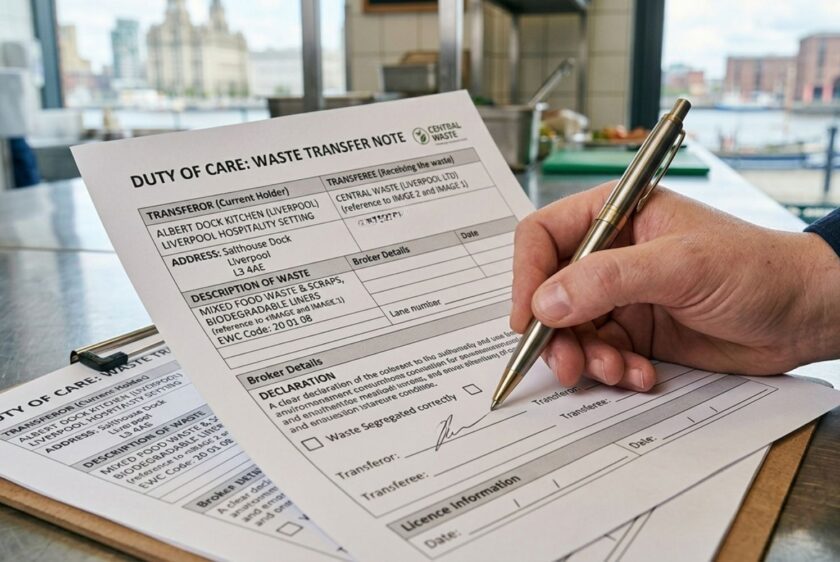
To stay compliant, your business must segregate waste correctly and use a verified, registered waste carrier. You are also legally required to hold valid ‘Duty of Care’ waste transfer notes, which document the type of waste, the weight, and where it is being disposed of. Failing to dispose of commercial waste legally, or handing it over to an unlicensed cowboy operator, can result in severe penalties, including prosecution and maximum fines of up to £5,000.
The Waste Hierarchy: Prevent, Reuse, Recycle
A core part of modern food waste management UK strategies is adopting the “waste hierarchy”, a model championed by the MRWA that prioritises preventing waste first, reusing what you can, and recycling the rest.
- Prevent: Waste reduction starts in the kitchen. Implementing smart inventory management (like the FIFO method), controlling portion sizes, and ensuring staff understand the difference between “Best Before” and “Use By” date labels can drastically cut down on spoiled food and plate waste.
- Reuse and Redistribute: If you have surplus edible food that hasn’t spoiled, it doesn’t need to go in the bin. Many businesses successfully reduce waste by selling unsold items at a discount through apps like TooGoodToGo, or by donating it to local community groups, homeless shelters, and charities like FareShare.
- Recycle: For unavoidable waste—like vegetable peelings, bones, and plate scraps—recycling is the answer. Instead of rotting in a landfill, segregated food waste is transported to a facility where it undergoes anaerobic digestion. This process uses microorganisms to break down the food, converting it into bio-fertiliser and renewable biogas that can be used to power the national grid.
Stay Compliant with Central Waste
Ensuring your business meets all food waste management UK regulations doesn’t have to be a headache. Established in 1977, Central Waste is a fully licensed, family-run waste carrier dedicated to keeping Liverpool and Merseyside clean, compliant, and green.
We take the stress out of legal compliance by handling your administration and providing all your necessary Duty of Care waste transfer notes completely free of charge. Our team will help you set up dedicated 240-litre food waste wheelie bins—complete with fresh, clear liners after every collection—to ensure you are segregating correctly, maintaining hygiene, and avoiding rising landfill taxes.
Let us handle your compliance. Call the friendly Central Waste team today on 0151 733 5551 to request your free site audit and streamline your food waste management.
Liverpool's Commercial Waste Experts
Ready to Sort Your Business Waste? Get a Free Quote in 2 Minutes.
Central Waste has been keeping Liverpool businesses waste-free since 1977. General waste, recycling, food waste, glass, oils — we cover it all across Merseyside. 7-day service, price-match promise, no obligation.
Get a Free Quote →229 five-star Google reviews · Serving Liverpool businesses since 1977 · 7-day service